
As the second wave of the pandemic ebbs and the daily caseload falls, the struggles of the urban poor have come into focus. Many have suffered income and job losses after two successive waves. The second wave, in particular, has seen the poor being hit hard on account of lack of medical and financial help. For the fast-moving consumer goods (FMCG) companies this has meant that an important segment is under severe distress.

Sanjiv Mehta, chairman of the country's largest consumer goods company, HUL, believes that the second wave of the Covid-19 pandemic between April and June this year has been a mere pause in India's consumption story, and that it will not change the country's overall growth trajectory. India is poised for growth, especially in the fast-moving consumer goods (FMCG) sector, Mehta told shareholders at the company's annual general meeting on Tuesday. The signs of recovery are becoming evident with many states lifting lockdown restrictions in recent weeks.

Chinese telecom gear giant Huawei Technologies has sought permission for access to the government's 'Trusted Telecom Portal' which went live on June 15 so that it can share details about the telecom products which telecom service providers have agreed to buy from it. The move is significant as sources close to the development say that, according to Chinese telecom companies' interpretation, the new National Security Directive on the telecom sector does not in any way prohibit them from participating in the process of selling telecom equipment of any kind to private telcos. The firm is waiting for a response from the government. It declined to comment.

Colgate-Palmolive India is placing greater emphasis on freshness, whitening, therapeutic, and family toothpastes, as rivals such as Dabur and Patanjali dominate the growing naturals segment of the market. Once under 5 per cent of the Rs 10,000-crore domestic toothpaste market, the naturals segment, which includes ayurvedic and herbal variants, is now 25-30 per cent of the market, industry executives said. Growth rates of the naturals segment are estimated to be in the region of 8-9 per cent in volume terms. In value terms, the growth rate for naturals is around 10-12 per cent, sector experts said.

Advertising on television continued to show momentum in May despite the surge in Covid-19 infections and the temporary suspension of the Indian Premier League (IPL), a high-impact television property. The data shared by the Broadcast Audience Research Council of India (BARC) on Thursday shows that advertising volumes in May were up 64 per cent year-on-year. However, there was a marginal dip sequentially, that is, in comparison to April 2021, when advertising had touched a record high owing to the start of the summer season and the return of the IPL to India after being held in the United Arab Emirates in 2020.

'While most companies were bullish before the second wave of double-digit sales growth in FY22, that may not be the case now.'
Sensing a huge opportunity in the healthcare sector during the Covid-19 pandemic and its aftermath, private equity (PE) players are upping their investments in the space. According to data from research platform VCCEdge, the PEs have together invested a staggering $583.82 million in the first five months of 2021 in five deals, which is the highest investment in the sector in the last five calendar years - from 2016 to 2020. The second highest investment in the sector took place in 2017, when PEs invested $503 million in 18 deals, with an average deal size of $29. 9 million.

The Competition Commission of India (CCI) on Tuesday said that the proposed additional stake buy in United Breweries (UB) by Dutch major Heineken does not raise any competition concerns, effectively clearing the deal. In its order, the CCI said, "It is submitted that the proposed transaction does not give rise to competition concerns regardless of delineation of the relevant market for the purpose of this filing." UB is the country's largest beer company, while Heineken is the world's second-largest brewer after Anheuser-Busch (AB) InBev.

Zee is estimated to have paid around Rs 225 crore for the complete rights of Radhe. The total revenue that it may earn could be around Rs 135 crore, implying a shortfall of Rs 90 crore.

To create a community, the consumer can share the details of the offer with friends and family who want to buy the same goods.

Based on industry estimates, telecom companies, including Bharti Airtel, Reliance Jio, Vodafone Idea and BSNL, are expected to invest over $10 billion on buying 5G telecom equipment in the next five years as they transition from non-standalone networks to standalone 5G networks.

From helping their employees infected with the Covid-19 virus to vaccinating them or supporting the families of those who might have succumbed to the infection, several companies in India are trying to do their bit in this difficult time. Some have even widened their support net to include all stakeholders as well as an extended community. To the families of the employees it lost to Covid-19, Noida-headquartered IT services and consulting company HCL Technologies is, for instance, paying salary for a year, medical insurance for three years and extending support for their children's education for five years.

The Telecom Regulatory Authority of India (Trai) has directed the Cellular Operators Association of India (COAI) to make a presentation detailing the pros and cons of the controversial Indian 5G standard, also known as 5Gi, which the government has been pushing for. The move comes after serious differences emerged among telcos with regard to the technology's efficacy and implementation.

Consultants who help lease these properties say this is the steepest decline at least in a decade.

Since April, India has seen multiple strains of the coronanavirus sweep the nation, upending life and businesses alike. Out-of-home retail and discretionary categories such as durables, auto, fashion, lifestyle, hospitality, food services, travel, and tourism have been the worst-hit as Covid cases remain high, leaving state governments with no option but to curtail mobility and economic activity.
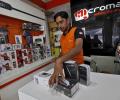
According to research firm IDC, a slowdown in smartphone shipments began showing up as early as late February, though companies insist that the March quarter was fine, albeit on a low base.

'I remain optimistic that 2021 will be better than 2020 because we have visibility of vaccinations this year.'
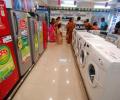
Some companies argue that the culture of staying, working and learning at home will persist for a while, altering lifestyle habits of consumers.
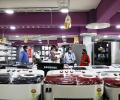
Durable goods companies and retailers say online sales won't compensate for the fall in offline sales.
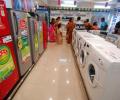
Maharashtra, which contributes between 12 and 15 per cent of appliances sales, announced lockdown-like curbs, meaning there will be no business for the second half of the month as well from the state.
